
Devon Rex: Complete Guide to Care, Personality & Health
Complete Devon Rex breed guide covering their pixie-like appearance, very-high energy personality, curly coat care, health concerns, and the best products for this playful Shorthair breed.
Devon Rex at a Glance
Good With
Temperament
Health Considerations
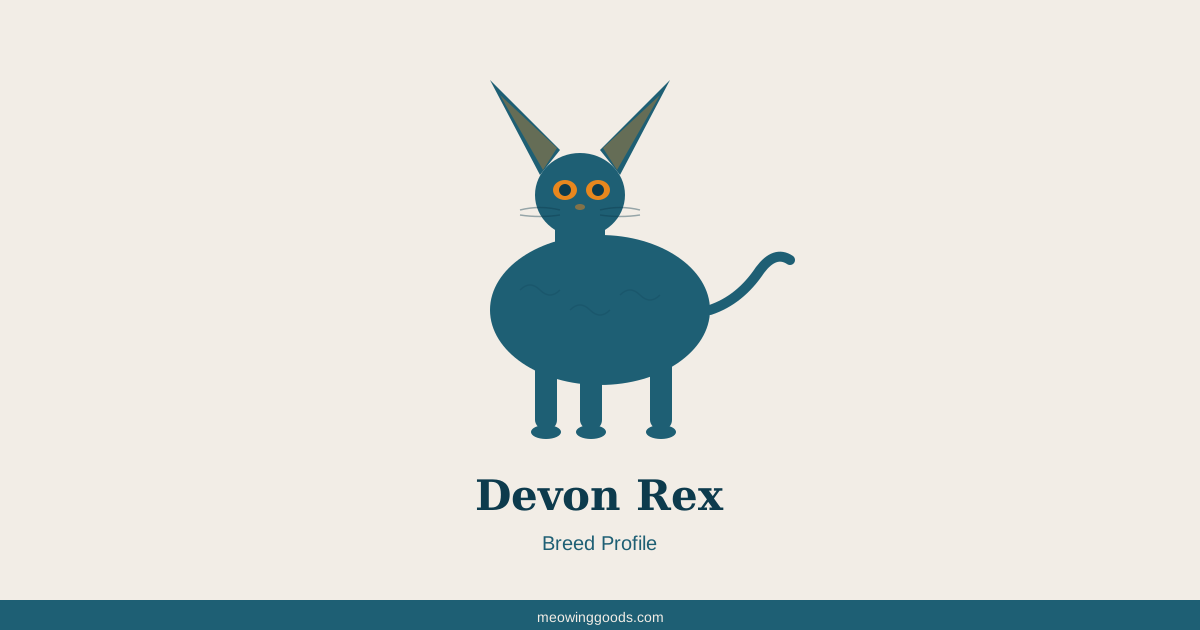
If a fairy tale elf were transformed into a cat, the result would be the Devon Rex. With oversized bat-like ears, enormous mischievous eyes, a wavy coat that looks like crushed velvet, and a personality calibrated entirely for maximum entertainment, the Devon Rex is one of the most distinctive and endlessly entertaining cat breeds alive. They are tiny chaos agents wrapped in curly fur, and they will steal your heart approximately three seconds after they steal your dinner off your plate.
Meowing Goods is reader-supported. When you buy through links on our site, we may earn an affiliate commission at no extra cost to you. Learn more
Breed Overview
The Devon Rex is a small, short-coated cat breed distinguished by its unique curly coat, pixie-like facial structure, and relentlessly playful personality. Originating from Devonshire, England in the late 1950s, the Devon Rex is the result of a natural genetic mutation that produces a soft, wavy coat unlike any other domestic cat breed.
The Cat Fanciers’ Association (CFA) describes the Devon Rex as having “an elfin face, large eyes, and oversized ears” on a “slender, fine-boned body” — a description that captures the breed’s otherworldly appearance but barely hints at its explosive personality. These are cats that live at maximum intensity from the moment they wake up until they collapse into your lap for a nap, at which point they will insist on maximum physical contact until they recharge for the next round of mayhem.
Despite their delicate appearance, Devon Rex cats are hardy, adaptable, and remarkably athletic. Their small size (typically 5 to 10 pounds) belies a fearless, confident temperament that has no trouble dominating a household of much larger cats — and dogs.
History & Origin
The Devon Rex’s story begins in 1959 in Buckfastleigh, Devon, England, where a curly-coated feral tom cat was observed living near an abandoned tin mine. A local woman named Beryl Cox noticed this unusual curly-coated tom and was intrigued. When one of her straight-coated female cats produced a litter that included a single curly-coated male kitten, Cox recognized something special. She named the kitten Kirlee.
Initially, breeders assumed that Kirlee’s curly coat was caused by the same gene responsible for the Cornish Rex — a curly-coated breed that had been discovered in Cornwall, England, a decade earlier in 1950. When Kirlee was mated to Cornish Rex females, however, all the resulting kittens had straight coats. This proved definitively that the Devon Rex and Cornish Rex curly coats were caused by entirely different, unrelated genetic mutations. The Devon Rex gene is designated Gene II (or the re gene), while the Cornish Rex gene is Gene I (the r gene).
With this discovery, breeders set about developing the Devon Rex as a distinct breed. Kirlee became the foundation sire — every Devon Rex alive today traces its ancestry back to this single curly-coated kitten from Devon. Careful outcrossing to Siamese, Burmese, British Shorthair, and American Shorthair expanded the gene pool and improved genetic health while preserving the distinctive curly coat and pixie-like facial structure.
TICA recognized the Devon Rex in 1979, and CFA granted championship status in 1983. Today, the Devon Rex is a well-established and increasingly popular breed worldwide, celebrated for its unique appearance and irresistible personality.
Physical Characteristics
The Devon Rex looks like no other cat — its combination of features creates an appearance that is alternately described as elfin, alien, pixie-like, and bat-eared. No single adjective captures it; the Devon Rex must be seen to be appreciated.
Head and Face
The Devon Rex head is a modified wedge shape with full cheeks and a prominent whisker break, creating the distinctive “pixie” face that defines the breed. The forehead curves back to a flat skull, and the muzzle is short with a strong chin and visible whisker pads. The eyes are large, wide-set, and oval-shaped, contributing to the breed’s impish, alert expression. Eye color corresponds to coat color and includes green, gold, hazel, and blue in pointed varieties.
The ears are the Devon Rex’s most iconic feature — they are very large, set low on the head, and exceptionally wide at the base, giving the cat a bat-like or elfin silhouette. The ears may have tufts of curly fur at the tips and along the outer edges.
Body
The Devon Rex is a small, slender cat with a hard, muscular body. Males typically weigh 7 to 10 pounds, while females range from 5 to 8 pounds. The body is medium-length with a broad chest and a distinctive “pixie” stance — the hind legs are slightly longer than the front legs, giving the cat an alert, forward-leaning posture. The legs are long and slim, with small, oval paws. The tail is long, fine, and tapering, covered in the breed’s characteristic curly or wavy fur.
Despite their delicate, lightweight build, Devon Rex cats are powerful jumpers and agile climbers. They are stronger and more athletic than they appear — a five-pound Devon Rex can clear a six-foot cat tree in a single bound.
Coat
The Devon Rex coat is short, soft, and wavy — sometimes described as feeling like crushed velvet, suede, or a soft chamois. The curl pattern varies across the body: the chest and abdomen typically have the loosest, softest curls, while the back and sides have a more defined wave pattern. Some Devon Rex cats may have sparser areas on the chest, belly, or temples, which is considered normal for the breed.
The coat comes in virtually every color and pattern, including solid, tabby, tortoiseshell, calico, pointed, bi-color, and smoke. The curly whiskers are a charming breed signature — they are short, brittle, and may curl or break, sometimes appearing as mere stubs.
Importantly, the Devon Rex sheds significantly less than most cat breeds because the curly coat structure traps loose hair rather than releasing it into the environment. This reduced shedding is a practical advantage, though it does not make the breed hypoallergenic.
Personality & Temperament
The Devon Rex personality is best described as a permanent state of delighted mischief. These cats approach life with an enthusiasm and creativity that borders on the absurd.
Perpetual Kittens
Devon Rex cats retain their kitten-like playfulness throughout their entire lives. Where many cat breeds settle into dignified middle age, the Devon Rex at ten years old is often just as wild, curious, and acrobatic as it was at ten months. They chase toys with genuine excitement, invent games with household objects, and display a joyful physicality that keeps their owners constantly entertained — and occasionally exhausted.
Social and People-Focused
Devon Rex cats are intensely social and form powerful bonds with their humans. They are lap cats, shoulder cats, and under-the-blanket cats — they want to be wherever you are and as close to you as physically possible. They greet visitors with curiosity rather than fear, get along well with children and other pets, and generally treat every new person as a potential friend and source of warmth.
Mischievous Problem-Solvers
The Devon Rex’s intelligence is both a gift and a challenge. They learn quickly, figure out latches, open doors, and can be taught tricks and commands. But their cleverness also means they will find their way into cupboards, onto forbidden countertops, and into situations that would stump less resourceful cats. Food left unattended on a counter has approximately zero chance of survival in a Devon Rex household — these cats are notorious food thieves who will eat anything they can reach.
Heat-Seeking
Due to their thin, sparse coat, Devon Rex cats are perpetual heat-seekers. They will find the warmest spot in any room — on top of a laptop, in front of a heating vent, under a blanket, or pressed against your body. This temperature-driven behavior makes them exceptionally cuddly and is one of the traits that endears them most to their owners.
Health & Lifespan
The Devon Rex has an average lifespan of 12 to 16 years and is generally a healthy breed. However, several genetic conditions are known to affect the breed at elevated rates.
Devon Rex Myopathy
Also called spasticity, this is a hereditary muscle condition specific to the Devon Rex breed. It typically appears between 3 weeks and 6 months of age and causes progressive muscle weakness, particularly in the head, neck, and limbs. Affected cats may have difficulty eating, show an unusual head bobbing, and tire quickly during activity. There is no cure, but mildly affected cats can live comfortable lives with appropriate management. A genetic test is available, and responsible breeders screen for this condition.
Hypertrophic Cardiomyopathy (HCM)
As with many cat breeds, HCM — the thickening of the heart muscle — can occur in Devon Rex cats. Regular cardiac screening via echocardiography is recommended, especially for breeding animals.
Patellar Luxation
This orthopedic condition, where the kneecap slips out of its normal position, occurs at higher rates in Devon Rex cats than in the general cat population. Signs include intermittent lameness, abnormal gait, and reluctance to jump. Mild cases may require no treatment, while severe cases may need surgical correction.
Malassezia Dermatitis
The Devon Rex’s thin coat and increased skin oil production can predispose them to Malassezia yeast infections, which cause greasy, flaky, or itchy skin — particularly in the ear canals, around the nails, and in skin folds. Regular gentle cleaning and veterinary management keep this condition under control.
Dental Disease
Devon Rex cats are prone to dental issues including gingivitis and tooth resorption. Regular dental checkups and at-home teeth brushing help prevent serious dental disease. For tips on maintaining oral health, see our cat grooming guide.
Grooming & Care
The Devon Rex has minimal grooming needs — their short, sparse coat is one of the lowest-maintenance in the cat world. However, “low maintenance” does not mean “no maintenance.”
Coat Care
Gentle is the operative word when grooming a Devon Rex. Their curly coat is fragile, and aggressive brushing can pull out or break the delicate hairs. A soft rubber brush like the KONG ZoomGroom is ideal — its gentle nubs remove loose hair and massage the skin without damaging the coat. Brush lightly once a week and avoid over-brushing. Some Devon Rex cats develop temporary bald patches, which is considered normal and usually resolves as the coat cycles.
Bathing
Devon Rex cats may need occasional baths — roughly once a month — because their sparse coat does not absorb skin oils as effectively as a full coat would. Greasy buildup can be particularly noticeable on the chest, paw pads, and around the nail beds. Use a gentle, moisturizing cat shampoo and warm water.
Ear Care
The Devon Rex’s large, open ears collect dirt and produce earwax readily. Weekly ear checks and gentle cleaning with a veterinarian-approved ear solution prevent buildup and infections.
Nail and Dental Care
Trim nails every 2 weeks and brush teeth 2-3 times per week. The Devon Rex’s predisposition to dental disease makes oral care especially important for this breed.
Diet & Nutrition
The Devon Rex is an enthusiastic eater — some would say too enthusiastic. These cats will eat just about anything, attempt to steal food from your plate, and show remarkably little discrimination about what constitutes “food.” Managing their diet requires vigilance.
Key Nutrition Priorities
- High protein — Support the Devon Rex’s lean, muscular build with a diet rich in named animal proteins. These are active cats who need fuel for their relentless energy.
- Portion control — Despite their small size, Devon Rex cats have hearty appetites and can become overweight if allowed to overeat. Measured meals are preferable to free-feeding for this breed.
- Puzzle feeders — The Catit Senses 2.0 Digger serves double duty as mental enrichment and a speed-eating deterrent. Devon Rex cats inhale their food if given the opportunity.
- Wet food — Regular wet food inclusion supports hydration and provides the concentrated protein these active cats need.
- AAFCO certified — Only feed food certified as “complete and balanced” by AAFCO for your cat’s life stage.
For a comprehensive breakdown of nutrition options, see our guide on best cat food.
Living Environment
Devon Rex cats are adaptable and can thrive in apartments, houses, and most living situations — as long as their core needs for warmth, companionship, and stimulation are met.
Warmth
The Devon Rex’s thin coat provides minimal insulation. Keep indoor temperatures comfortable (68-77 degrees Fahrenheit), provide heated beds like the K&H Thermo-Kitty Heated Cat Bed, and offer cozy blankets and enclosed sleeping spots. Many Devon Rex owners use cat sweaters in winter, and most Devon Rex cats accept — even appreciate — wearing them.
Vertical Space
Devon Rex cats are extraordinary climbers and jumpers who need vertical territory. Tall cat trees, wall-mounted climbing shelves, and high perches are essential. They will reach the highest point in any room, so ensure shelves are stable and valuables are secured.
Mental Stimulation
Interactive toys, puzzle feeders, rotating toy selections, and daily play sessions prevent boredom and the creative destruction that follows. Consider toys that challenge their problem-solving skills — the Devon Rex will master simple toys quickly and lose interest.
Companionship
Like their Burmese relatives, Devon Rex cats are highly social and should not be left alone for extended periods. A second cat or another companion pet prevents the loneliness and anxiety that can develop in solitary Devon Rex cats.
Is This Breed Right for You?
A Devon Rex May Be Perfect If You:
- Want a small, endlessly entertaining cat with a huge personality
- Love physical affection — lap sitting, shoulder perching, and under-blanket snuggling
- Have children or other pets who enjoy active, playful interactions
- Are home frequently or can provide a feline companion
- Appreciate a unique, head-turning appearance that sparks conversations
- Want a lower-shedding cat (though not hypoallergenic)
A Devon Rex May Not Be Ideal If You:
- Want a calm, dignified, low-energy cat (consider a Persian or Exotic Shorthair instead)
- Leave food unattended regularly — Devon Rex cats are champion food thieves
- Prefer a hands-off pet who entertains itself quietly
- Are away from home for long hours without a companion animal
- Want a large, imposing cat — the Devon Rex maxes out around 10 pounds
- Expect a cat who respects boundaries around countertops and tables
Recommended Products for Devon Rex Cats
Based on the Devon Rex’s specific needs — very-high energy, delicate curly coat, temperature sensitivity, and food-motivated intelligence — here are the products we recommend:
-
Petstages Tower of Tracks — A three-tier ball track that provides independent stimulation for those moments between interactive play sessions. The Devon Rex’s batting instincts make this a perpetual favorite.
-
K&H Thermo-Kitty Heated Cat Bed — Essential warmth for a breed that gets cold easily. The heated bed provides a cozy retreat that draws your Devon Rex away from your laptop keyboard — sometimes.
-
KONG ZoomGroom Cat Brush — The perfect grooming tool for the Devon Rex’s fragile, curly coat. Gentle rubber nubs clean without pulling or breaking delicate hairs, and most Devon Rex cats treat grooming sessions as massage time.
-
Catit Senses 2.0 Digger — A puzzle feeder that slows down the Devon Rex’s enthusiastic eating while providing the mental challenge their clever brains require.
Frequently Asked Questions
Are Devon Rex cats hypoallergenic?
Devon Rex cats are sometimes marketed as hypoallergenic, but this is misleading. While they shed less than most breeds due to their sparse, curly coat, they still produce the Fel d 1 protein in their saliva and skin secretions that causes cat allergies. Some allergy sufferers report milder reactions to Devon Rex cats compared to heavy-shedding breeds, but there is no guarantee. If you have cat allergies, spend extended time with a Devon Rex before committing to ownership. Never rely on a single brief visit — allergies can worsen with prolonged exposure.
Do Devon Rex cats like to be held?
Devon Rex cats are among the most cuddly, physically affectionate cat breeds. They actively seek out human contact, will climb onto your shoulders, nestle into your lap, burrow under blankets with you, and prefer sleeping on or against their owners rather than in a separate bed. Their thin coat means they are drawn to body warmth, and most Devon Rex cats genuinely enjoy being held, carried, and snuggled. They are often described as “velcro cats” because of their determination to maintain physical contact.
How much exercise does a Devon Rex need?
Devon Rex cats have a very-high activity level and need significant daily exercise and mental stimulation. Plan for at least 30 to 45 minutes of active, interactive play spread throughout the day — wand toys, fetch, puzzle feeders, and climbing opportunities. Devon Rex cats are excellent climbers and jumpers and need vertical space like tall cat trees and wall-mounted shelves. Without adequate stimulation, they will create their own entertainment, which typically involves exploring forbidden surfaces, opening drawers, and redistributing household items.
Are Devon Rex cats good with children?
Devon Rex cats are excellent with children. Their playful, energetic, and sturdy temperament makes them natural playmates for kids who understand gentle handling. They are rarely aggressive, have a high tolerance for the activity and noise that comes with children, and often seek out kids specifically because of the play opportunities they provide. Their small size means very young children should be supervised to prevent accidental rough handling, but the Devon Rex’s social nature makes them one of the most child-friendly breeds available.
What is the difference between a Devon Rex and a Cornish Rex?
Despite both being “Rex” breeds with curly coats, the Devon Rex and Cornish Rex are genetically distinct — their curly coats are caused by different gene mutations and the two breeds cannot produce curly-coated offspring when crossed together. Physically, the Devon Rex has a wider head, larger low-set ears, a shorter muzzle, and a pixie-like facial expression. The Cornish Rex has a longer, more egg-shaped head, high-set ears, a Roman nose, and a more whippet-like body. The Devon Rex coat tends to be shorter and less uniformly curly than the Cornish Rex’s tighter, more even waves.
Sources
Recommended Products for Devon Rex Cats
Petstages Tower of Tracks
Devon Rex cats are perpetual-motion machines who need toys that match their relentless energy. The Tower of Tracks provides independent stimulation with three tiers of spinning balls that satisfy their batting and chasing instincts.
K&H Pet Products Thermo-Kitty Heated Cat Bed
Devon Rex cats have thin, sparse coats that provide minimal insulation. A heated bed gives them the warmth they constantly seek, especially in cooler environments.
KONG ZoomGroom Cat Brush
The Devon Rex's delicate curly coat requires gentle handling — stiff brushes can damage or pull out their fragile fur. The ZoomGroom's soft rubber nubs clean the coat without breakage while providing a massage they love.
Catit Senses 2.0 Digger
Devon Rex cats are exceptionally clever and will figure out simple puzzle toys in minutes. The Digger provides ongoing mental challenge at mealtimes, slowing down fast eaters while exercising their problem-solving skills.
Frequently Asked Questions
Senior Cat Product Reviewer & Feline Nutrition Specialist
Sarah has spent over 12 years testing and reviewing cat products — from premium kibble to the latest interactive toys. She holds a certification in feline nutrition and is an associate member of the International Association of Animal Behavior Consultants (IAABC). Sarah lives in Austin, Texas, with her three cats: Biscuit (a tabby with opinions about everything), Mochi (a Siamese who demands only the best), and Clementine (a rescue who taught her the meaning of patience). When she isn't unboxing the latest cat gadget, you'll find her writing about evidence-based nutrition, helping cat parents decode ingredient labels, and campaigning for better transparency in the pet food industry.